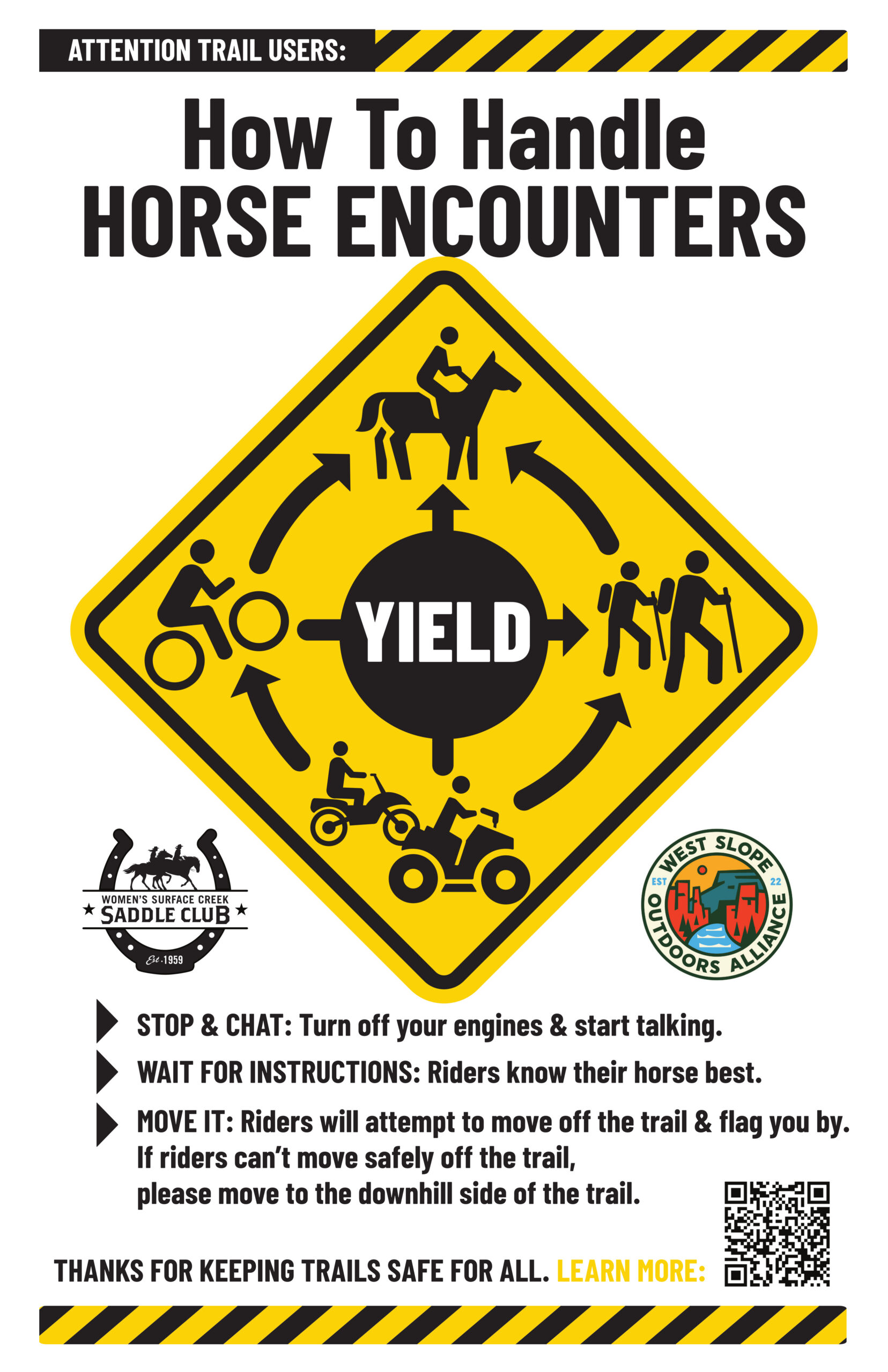
How To Handle Horse Encounters
By being mindful and considerate of each other, we can all contribute to a positive and safe experience on our shared trails!
↓ Scroll down for Bike and OHV guidelinesHikers & Runners
- Stop and Chat When you see horses, please stop moving and start talking. Your voice helps the horse recognize you as a human. Standing still shows the equine they have nothing to fear.
- Show Yourself Stand where the horse and rider can both see you. Please don't hide — the equine sees you as a predator waiting to attack.
- Wait for Instructions The equestrian knows their horse best and can direct you in a way that keeps everyone safe.
- Go Downhill If possible, step to the downhill side of the trail. Horses tend to feel safer when potential threats are below them.
- Scoot to the Same Side If you are more than one, please all move to the same side of the trail.
- Control Pets Always keep your pets under control and close to you when horses are nearby.
Mountain Bikers
- Pull Over Promptly As soon as you spot horses, pull to the side of the trail, far enough to allow them to pass safely.
- Choose Downhill If you can, move to the downhill side of the trail. Horses often perceive uphill movement as a potential threat.
- Be Seen & Heard Clearly Speak to the rider and horse in a friendly, relaxed tone. If your helmet covers part of your face, consider removing it temporarily — this helps the horse see you as a person.
- Approaching from Behind If you're coming up behind horses, stop, call out to the rider, and make your presence known.
- Ask Before Passing Always ask the rider if it's okay to pass and what the best way to do so is. Equestrians will attempt to move off the trail and let you pass in a safe area.
- Wait for Instructions Even if an equestrian pulls over when they hear you, it doesn't automatically mean it's safe to ride past. Stop and wait for their guidance — they know their horse best!
- Follow Their Lead They might ask you to stay put while they ride past, or move aside and ask you to ride or walk your bike past them.
- Pass Slowly and Smoothly If given the go-ahead, do so at a slow, steady pace. Avoid sudden movements or loud sounds that could startle the horse.
- Stay Alert Always be on the lookout for oncoming traffic, including other horses.
OHV Users
- Pull Over Promptly As soon as you spot horses, pull to the side of the trail, far enough to allow them to pass safely.
- Choose Downhill If you can, move to the downhill side of the trail. Horses often perceive uphill movement as a potential threat.
- Shut Down & Be Seen Shut off your motor as soon as possible and remove your helmet. This helps the horse recognize you as a human.
- Speak Clearly Greet the rider and horse in a friendly, relaxed tone.
- Approaching from Behind If you're coming up behind horses, stop, call out to the rider, and make your presence known.
- Ask Before Passing Always ask the rider if it's okay to pass and what the best way to do so is.
- Wait for Instructions Even if an equestrian pulls over when they hear you, it doesn't automatically mean it's safe to ride past. Stop and wait for their guidance — they know their horse best!
- Follow Their Lead They might ask you to stay put while they ride past, or move aside and ask you to drive your OHV past them.
- Pass Carefully If given the go-ahead, keep your RPMs low and steady, and your sound as low as possible. Sudden movements or loud sounds can easily startle horses.
- Stay Alert Always be on the lookout for oncoming traffic, including other horses.
Our Guide to a Safe & Enjoyable Trail Ride
Partners in Safety – Essential Guidelines:
To ensure every ride is a safe, fun, and relaxing experience for all equines and riders in our sisterhood, we ask that everyone adhere to these shared responsibilities:
- Own Your Partnership: Take full responsibility for the actions and behavior of your equine partner on the trail. We are here to support each other, not assign blame.
- Be Trail Aware: Be mindful of how your movements and your equine’s reactions may impact the horses and riders around you. Your behavior sets the tone for the entire group.
- Maintain Safe Distance: Always keep a minimum of two horse lengths between equines. As a visual check, if you cannot clearly see the back shoes of the horse in front of you, you are riding too closely.
- Practice Consideration & Patience: Be aware that other riders in the group may be less experienced. Always maintain a steady, shared pace (stay at a walk). Sudden changes in speed or zooming past others can trigger anxiety and a flight response in horses behind you.
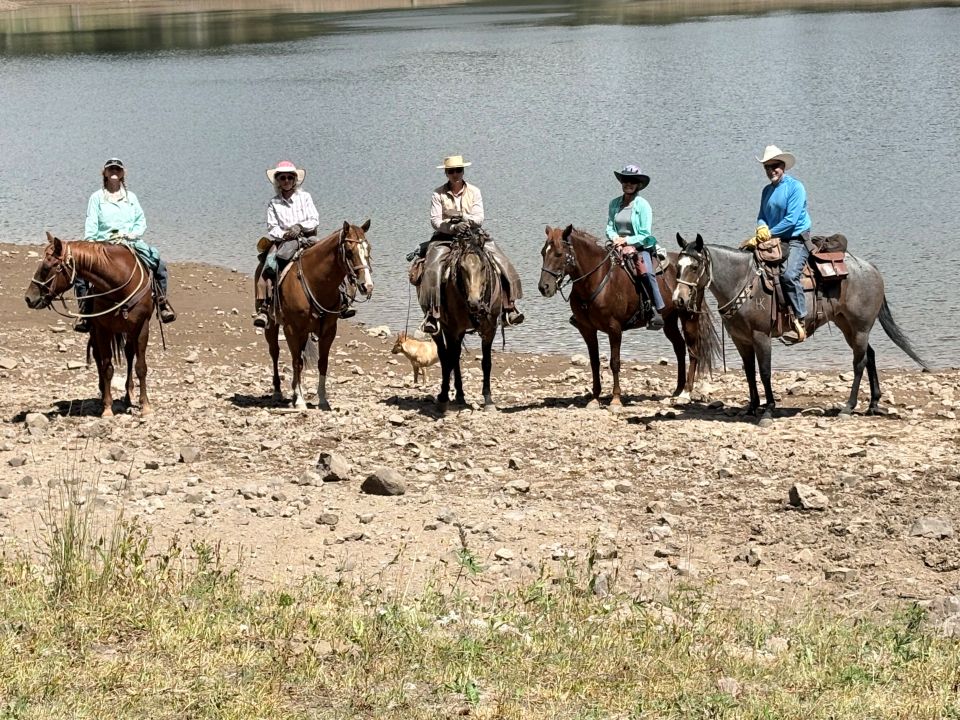
HAVE FUN! Stay positive, stay calm, and enjoy the adventure. Remember, the WSCSC is a sisterhood dedicated to supporting each other on our equine journey.
Choose Your Adventure: Trail Ratings & Rider Responsibility
WSCSC’s club rides require the commitment of both members, guests and the designated Trail Boss to ensure group safety.
Understanding Our Trail Rating System
WSCSC uses a difficulty rating system based on standard trail identifiers. Please use these to gauge the technicality and challenge of each ride:
🟢 Green (Easy):
6 miles or less – Primarily flat terrain, wide trails, and minimal obstacles. Suitable for all riders and green horses. Pace is a steady walk.
🔵 Blue (Intermediate):
12 miles or less – May include hills, small water crossings, or uneven footing. Requires a moderate level of fitness for horse and rider.
⚫ Black (Advanced):
20 miles or less – Technical terrain, steep grades, deep water, or narrow cliffside trails. Recommended for experienced partnerships with high fitness levels.
Your Responsibility: Choosing the Right Fit
We rely on every member’s and guest’s good judgment to ensure a safe and enjoyable experience for the entire group. Before signing up for any ride:
- Honest Assessment: Please evaluate your own physical abilities (strengths and limitations) as well as your horse’s current level of fitness and trail experience. Choosing a ride that matches your partnership is the first step to success.
Trail Safety Policy
Our priority is always the safety of the entire herd. While we ride as a supportive sisterhood, clear expectations are necessary:
Riders Responsibility:
- Contact Trail Boss with questions.
- Contact Trail Boss if you plan to join the ride.
- Trail Boss provides READY TO RIDE TIME (RTRT).
- RTRT = all tacked up and ready to ride down the trail. Please plan accordingly.
- Trail Boss provides written driving directions to the Trailhead.
- Review “Safe and Enjoyable Trail Guide”.
- Bring Signed Waivers/Emergency Contact info, give to Trail Boss.
- Riding Helmets are encouraged but not required for Adults.
- Riders 18 and under helmets are required.
- Green rides are PotLuck, bring a dish to share and your drink.
- Blue and Black rides, bring lunch and your drink.
- If your plans change and you can’t join us – PLEASE text the Trail Boss, so she doesn’t wait and worry about you.
Birthday Rides: Green or Blue Rides
- No Dogs allowed on GREEN & BLUE Club Rides
- Dogs will be allowed on BLACK Trails if the Trail boss and all the riders are in agreement.
SAFETY IS PRIORITY
Adapted for WSCSC from Backcountry Horseman of California and NATRC’s Quick Tips
TRAIL HEAD/PARKING AREA
- Be on Time and park considerately.
- Tack Up, bring halter, lead rope, water, lunch, jacket/rain gear, hoof pick, knife.
- Clean up manure, hay, litter at Trail Head or camping area.
- Use ribbons to denote special situations, Red Ribbon if equine kicks, Yellow Ribbon denotes a stallion.
- WSCSC strongly encourages the use of riding helmets but they are not required.
WHILE ON THE TRAIL
- Trail Boss is the boss. If you are riding in an unsafe manner, pose a danger to other riders, you will be asked to modify your behavior or leave the ride.
- Stay behind the trail leader (not always the Trail Boss) and in front of the drag rider. If you are having a problem call out for a STOP and don’t hesitate to ask for help.
- When mounting to ride, keep your horse still until everyone is mounted. Don’t crowd the equine in front of you. Leave a horse length between equines even at stops.
- In difficult or steep terrain allow more space and keep moving. If you need to stop for any reason, wait until the trail leader finds a suitable place where all can stop safely.
- Approach other riders from behind slowly.
- Pass with permission at a walk. After passing, move to create a safe space. Be careful not to spook others with your actions.
- Advise others of obstacles such as, low branches, holes in the trail, hikers ahead.
- Leave gates as you find them. When a rider dismounts to open a gate, a few riders wait until she has remounted.
- Crossing water, allow the first equines to drink, then move up the trail and wait.
- Don’t crowd or allow your equine to charge into the water. The group does not leave until all have watered.
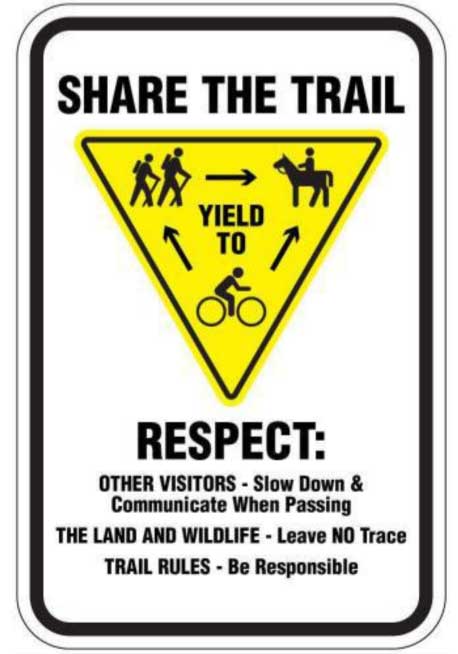
- Be courteous and friendly to other trail users. Smile, initiate a conversation so the equines can identify a non-threatening situation. All trail users should yield to the equine.
- Most users have been trained to stop, turn off their engines and wait for instruction from the equine riders. Safety for all trail users is a priority.
- Stay on the trail; obey the rules and respect private property.
- When riding along a road, ride with the traffic. When crossing roads, cross abreast rather than singe file.
- Riding side by side is permissible. Yield to traffic passing in either direction.
- No smoking allowed on trails.
TIPS FOR BREAKS OR LUNCH STOP
- Tie equines safely, leave ample room for other to pass, don’t block the trail.
- Alcohol use can make riding dangerous, use discretion.
- Lunch is a good time to ask questions if you are unsure about anything, nothing is off limits.
- HAVE FUN
- LEAVE NO TRACE
- Please ride with a BIG SMILE. Enjoy every mile of your riding adventure with your equine and human friends.